
What Are the Top Barcode Security Labels for Buyers?
When buyers compare barcode security labels, appearance is only the starting point. A dependable label must support identification, tamper awareness, and accurate inventory control. It should scan quickly under ordinary warehouse lighting. It should also remain readable after handling, transport, and storage.
The best choice depends on the product, surface, and operating environment. Paper labels may suit short-term cartons, while synthetic materials often perform better on plastic containers or metal equipment. Adhesive strength matters, too. A label that lifts at one corner can weaken the entire tracking process. Buyers should examine barcode contrast, print durability, residue, and resistance to moisture, abrasion, temperature changes, and cleaning chemicals. Small details matter.
This guide focuses on practical evaluation rather than impressive claims. Request technical data, sample rolls, and documented quality controls from established suppliers. Then test labels on the actual products, not only on smooth laboratory surfaces. A small pilot helps reveal scanning failures, awkward application, and unexpected adhesive behavior. Record the results. Compare them against internal handling requirements and applicable industry expectations.
No label is perfect. Even a well-designed option can fail when applied to dusty, curved, or uneven surfaces. That limitation deserves attention. Buyers should also consider serialized numbering, inspection records, replacement procedures, and staff training. These elements create stronger traceability than a label alone. The right barcode security labels offer measurable protection, consistent scanning, and practical value without adding unnecessary complexity. Sometimes, the simplest label performs best.
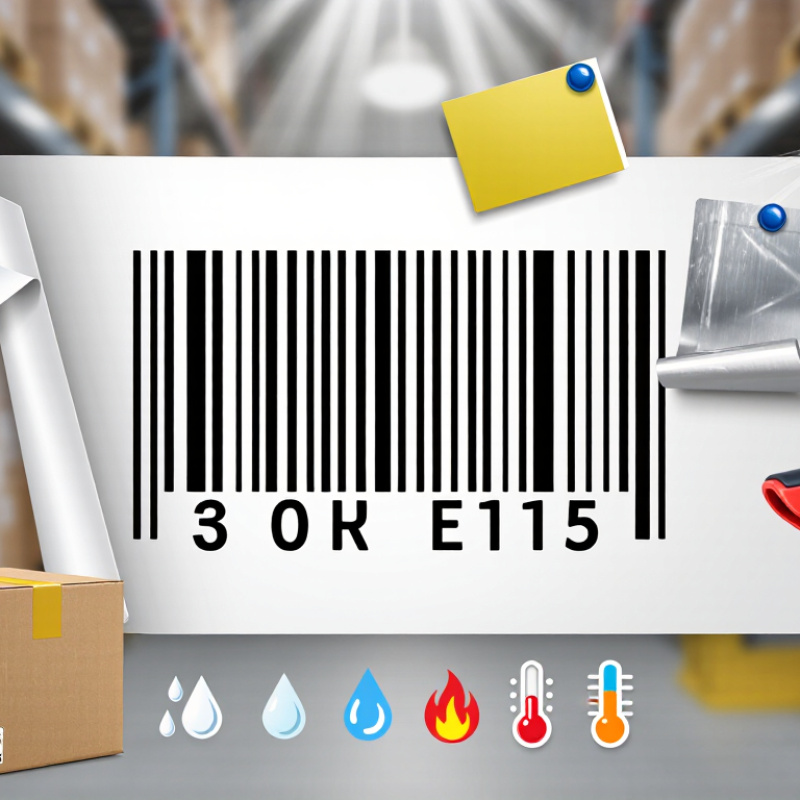
Define Overt, Covert, and Forensic Barcode Security Features
Choosing barcode security labels requires more than scanning speed. Buyers should match each feature to the product, packaging, and inspection environment. Overt features are visible without tools. They may include color-shifting ink, tamper-evident cuts, or a clear “void” message after removal. These cues help warehouse teams inspect cartons quickly. They also support customer confidence at delivery. In practical label audits, placement matters as much as the printed effect. A label crossing a carton seam can reveal lifting more clearly. A barcode still needs strong contrast and quiet zones. Security should not make routine scanning unreliable.
Covert features stay hidden during normal handling. UV-reactive marks, microtext, and infrared responses can help trained staff verify a label. However, a cheap UV torch may produce uneven results. Forensic features provide deeper examination. They can use microscopic patterns, spectral signatures, or traceable material characteristics recorded in controlled documentation. These features help when a disputed label needs expert comparison. Buyers should request test samples and inspection instructions. They should also review performance after abrasion, moisture, and temperature exposure. No feature is perfect. Human error remains possible, especially when teams rush.
Tips: Select one overt feature for fast checks and one covert feature for trained verification. Keep forensic testing separate from daily warehouse work. Ask how inspectors will record batch details, failed scans, and replacement labels. Test the label on the actual surface, not only on a smooth sample. Review results with operations staff. Their feedback may expose practical problems early. Recheck the design every few months. Packaging changes can quietly weaken security.
What Are the Top Barcode Security Labels for Buyers? - Define Overt, Covert, and Forensic Barcode Security Features
| Security Feature | How It Works | Barcode Visibility | Typical Verification Method | Primary Buyer Benefit | Common Applications | Important Limitations |
|---|---|---|---|---|---|---|
| Overt Barcode Security Label | Uses visible security graphics, warning text, serialized numbering, or a clearly identifiable tamper message on the label. | Clearly visible under normal lighting. | Visual inspection, barcode scanning, and comparison with a database record. | Provides fast authentication and visibly discourages unauthorized removal or replacement. | Asset tracking, shipping containers, warehouse inventory, equipment, and access-controlled items. | Visible features can be copied or photographed; visual inspection alone does not prove authenticity. |
| Tamper-Evident Destructible Label | The label uses a fragile face material or adhesive system that tears, fragments, or leaves a message when removal is attempted. | Barcode remains openly readable before tampering. | Check for broken material, residue, void wording, or missing fragments, then scan the barcode. | Makes label transfer to another item difficult and provides immediate evidence of removal. | Warranty seals, electronics, tools, containers, and serialized assets. | Performance depends on surface energy, temperature, application pressure, and dwell time. |
| Tamper-Evident Residue Label | Leaves a visible adhesive pattern, text, or coating on the application surface after removal. | Barcode is normally visible and scannable. | Inspect both the label and the protected surface for transfer marks or residue. | Provides strong evidence that the original label was removed from its intended location. | Cartons, doors, cabinets, packaging, and smooth painted or coated surfaces. | Residue may be unsuitable for porous, rough, oily, or highly textured surfaces. |
| Covert UV-Reactive Barcode Label | Includes security ink or a hidden marking that becomes visible under ultraviolet illumination. | Barcode or secondary identifier may be invisible or low-visibility in daylight. | Use an appropriate UV lamp and compare the revealed feature with an authorized reference. | Adds a discreet authentication layer without changing the ordinary appearance of the package. | Pharmaceutical packaging, documents, credentials, luxury goods, and controlled inventory. | Requires controlled lighting and trained personnel; some inks can degrade with prolonged UV exposure. |
| Covert Infrared-Readable Feature | Uses materials with different infrared absorption or reflection properties to create a hidden identifier. | Usually invisible or indistinguishable under ordinary visible light. | Requires an infrared-capable scanner, camera, or inspection system. | Makes casual copying more difficult and supports automated authentication. | High-value assets, secure logistics, controlled documents, and regulated products. | Specialized equipment increases verification cost and may require system calibration. |
| Microtext Barcode Security Label | Adds extremely small text or characters that appear as lines to the unaided eye but can be examined with magnification. | Barcode is visible; microtext is difficult to read without magnification. | Use a loupe, microscope, or high-resolution imaging system. | Supports inspection of print detail and increases the difficulty of producing an accurate counterfeit. | Certificates, product labels, serialized packaging, and authentication documents. | Very small text can lose clarity if printed at insufficient resolution or exposed to abrasion. |
| Guilloche or Fine-Line Pattern | Uses intricate, interlaced line patterns that are difficult to reproduce accurately with basic printing or scanning. | Visible under normal lighting, often surrounding the barcode or serialized data. | Visual comparison, magnified inspection, or image-based verification. | Improves print-level authentication while preserving a professional label appearance. | Certificates, premium packaging, identification labels, and controlled documents. | May not stop a well-funded counterfeit operation if used without other security layers. |
| Forensic Chemical or Taggant Feature | Incorporates a proprietary chemical marker or material signature that is difficult to identify without specialized analysis. | Typically invisible or not distinguishable during routine handling. | Laboratory testing or a dedicated field test supplied to authorized inspectors. | Provides strong evidence for investigations, disputes, and supply-chain authentication. | High-value goods, regulated products, legal evidence, and sensitive supply chains. | Verification can be slower, more expensive, and dependent on secure reference samples or procedures. |
| Serialized 1D Barcode Label | Assigns a unique machine-readable identifier to each item, package, or asset. | Visible and scannable with a compatible barcode reader. | Scan the code and validate its number, status, and transaction history in a database. | Enables item-level traceability, inventory control, and detection of duplicate serial numbers. | Inventory, logistics, maintenance records, retail packaging, and asset management. | A copied barcode may scan successfully unless the database, label construction, or additional security feature detects the copy. |
| Serialized 2D Barcode Security Label | Stores more data in a compact two-dimensional symbol, such as a unique serial number, batch, expiry date, or verification URL. | Visible and readable with an imaging scanner or suitable mobile device. | Scan and validate encoded data against authorized records or a secure verification service. | Supports detailed traceability and can retain readability despite limited label space or partial damage. | Pharmaceuticals, electronics, spare parts, medical devices, and serialized logistics units. | Authentication depends on secure data management; the code itself should not be treated as proof of authenticity. |
| Integrated Multi-Layer Label | Combines two or more layers, such as a visible serial barcode, tamper evidence, covert ink, and database verification. | Uses both visible and hidden features. | Routine visual and barcode checks, with covert or forensic examination for escalated cases. | Creates layered protection suitable for different inspection levels and risk conditions. | High-value products, regulated supply chains, warranty control, and security-sensitive assets. | Higher material, printing, training, and verification costs require careful program management. |