Top 10 Grounding Sleep Mat Types for Global Buyers
Sleep quality has become a serious purchasing concern for global consumers. The CDC reports that about one in three U.S. adults does not get enough sleep regularly. This concern has expanded interest in products designed for nighttime comfort, including the Grounding Sleep Mat. Buyers now compare conductive fabrics, carbon layers, grounding cords, washable covers, and travel-friendly designs.
However, product popularity is not the same as clinical proof. The National Center for Complementary and Integrative Health notes that evidence for many complementary health approaches remains limited or mixed. Grounding research also includes small studies, varied methods, and different product designs. That matters when a supplier makes claims about sleep, stress, circulation, or inflammation. A reliable evaluation should examine material safety, electrical resistance, manufacturing controls, user instructions, and independent testing. It should also consider local plug standards and household electrical conditions.
This guide reviews ten Grounding Sleep Mat types for international buyers. Each type is considered through practical details, such as a soft cotton surface, a thin conductive layer, or a cord that reaches a grounded outlet beside the bed. Comfort comes first. Safety remains essential. Reported benefits may differ between users, and some marketing language deserves closer questioning. Professional buyers should request test documents, warranty terms, and clear claims before placing an order. A mat can support a bedtime routine, but it should not replace medical advice or established sleep practices. The American Academy of Sleep Medicine emphasizes consistent sleep habits, while product research continues to develop. That uncertainty is worth acknowledging.
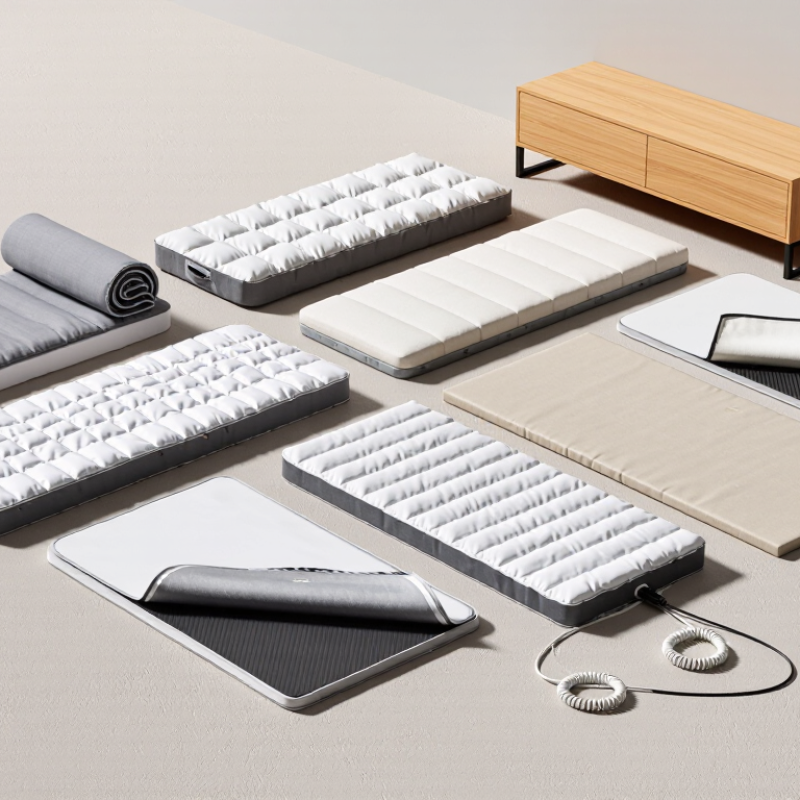
Grounding Sleep Mats: Conductive Paths, Materials, and Key Industry Terms
Grounding sleep mats differ by their conductive path, surface feel, and connection design. Common types include carbon-coated polyurethane, conductive rubber, conductive PVC, silver-thread fabric, stainless-steel fiber textile, carbon-fiber fabric, copper-mesh mats, aluminum-layer mats, conductive leather-like sheets, and hybrid foam mats. Each type transfers electrical potential through a cord to a verified ground connection. The mat itself does not create a grounding path.
Material choice matters. Carbon coatings can provide flexible coverage, but wear may reduce continuity over time. Metal fibers often conduct efficiently, although they can feel less comfortable against bare skin. Rubber offers grip and durability, while textile mats fold easily for travel. Key industry terms include surface resistance, continuity, grounding cord, grounding plug, conductive layer, insulation, and electrical earth. Surface resistance should be measured with suitable equipment, not guessed from touch.
A reliable purchasing check examines connector fit, cord strain relief, edge durability, and cleaning instructions. Confirm that the wall outlet has a functioning ground terminal. Never use a damaged cord or a questionable adapter. Claims need restraint. Electrical conductivity does not prove medical effectiveness, and personal results may vary. I would also question test results that omit humidity, body contact, or measurement conditions. No single material wins every test. A practical comparison should consider conductivity, comfort, maintenance, and documented safety information together.
Ten Mat Types by Construction: Carbon, Silver, Copper, and Hybrid Designs
Grounding sleep mats vary mainly by their conductive construction. Carbon fiber mats feel flexible and resist moisture, while carbon fabric spreads conductivity across a wider surface. Carbon-coated foam adds cushioning, but its coating may wear near folded edges. Silver-thread textiles offer excellent conductivity and a soft, fabric-like touch. Silver-coated mesh improves airflow, although loose threads can reduce long-term consistency. Copper foil provides strong conductivity and fast signal transfer, but it can crease or oxidize without proper protection.
Copper woven fabric balances flexibility and durability for regular bedroom use. Copper-infused polymer creates a smooth, washable surface, yet its conductivity depends on the compound’s concentration. Carbon-silver hybrids combine carbon’s durability with silver’s efficient conductivity. Copper-silver hybrids can provide stable performance, but they often cost more and require careful layer bonding. These ten types are not interchangeable. Surface feel, grounding resistance, cleaning method, and regional electrical compatibility all matter.
Tips: Check resistance with a reliable meter before regular use. Inspect seams, connectors, and folded areas. Verify the outlet ground with an approved tester, especially in older buildings. Never assume a conductive mat provides medical benefits. It is a household electrical accessory, not a treatment device. Buyers should also compare material declarations, test reports, and warranty terms. A small detail can matter. Some designs look similar but age very differently. Trade-offs remain, and no construction wins every test.
Global Buyer Criteria: Plug Standards, 100–240 V Systems, Durability, and Claims
Top 10 Grounding Sleep Mat Types for Global Buyers
Global buyers should verify plug compatibility before comparing mat materials. Type A, C, G, and I plugs are not interchangeable. IEC’s 2023 Annual Report lists 174 member countries, reflecting a complex standards environment. A safer product states its plug type, input range, frequency, and adapter approvals clearly. For 100–240 V systems, buyers should check whether the power unit supports both 50 and 60 Hz operation. IEC 60884-1 can guide household plug and socket requirements, while IEC 62368-1 may apply to certain external power supplies.
Durability needs more than a thick surface. Ask for bend testing, connector pull testing, surface resistance results, and cleaning instructions. A mat used nightly faces repeated rolling, body heat, moisture, and cable movement. Look for reinforced strain relief and replaceable cords. Small details matter. NFPA’s Home Structure Fires research continues to identify electrical distribution equipment as an important ignition category, so overheating protection and traceable testing deserve attention. Buyers should also review batch records, not only product photos.
Claims require restraint. A grounding mat can describe electrical continuity, but unsupported sleep, pain, or detox promises weaken credibility. Evidence should separate laboratory readings from health outcomes. I would not treat one resistance measurement as proof of safety. Some product pages still confuse measured conductivity with clinical benefit. That distinction needs correction. Test certificates, clear warnings, and independent verification provide stronger evidence than dramatic wording.
Top 10 Grounding Sleep Mat Types for Global Buyers
Buyer-screening comparison based on plug standards, 100–240 V system compatibility for optional accessories, durability, and claim clarity.
Scores use a 1–5 screening scale derived from common product characteristics: material service life, ease of global distribution, grounding-interface practicality, and clarity of electrical or wellness claims. Passive grounding mats do not normally require mains power; 100–240 V applies only to optional powered accessories or testing equipment. Plug compatibility should be verified for the destination market, including Type A/B, C/F, G, I, J, and L systems.